 Thread
Bible Study
Thread
Bible Study
Scripture in its own world, five minutes at a time.
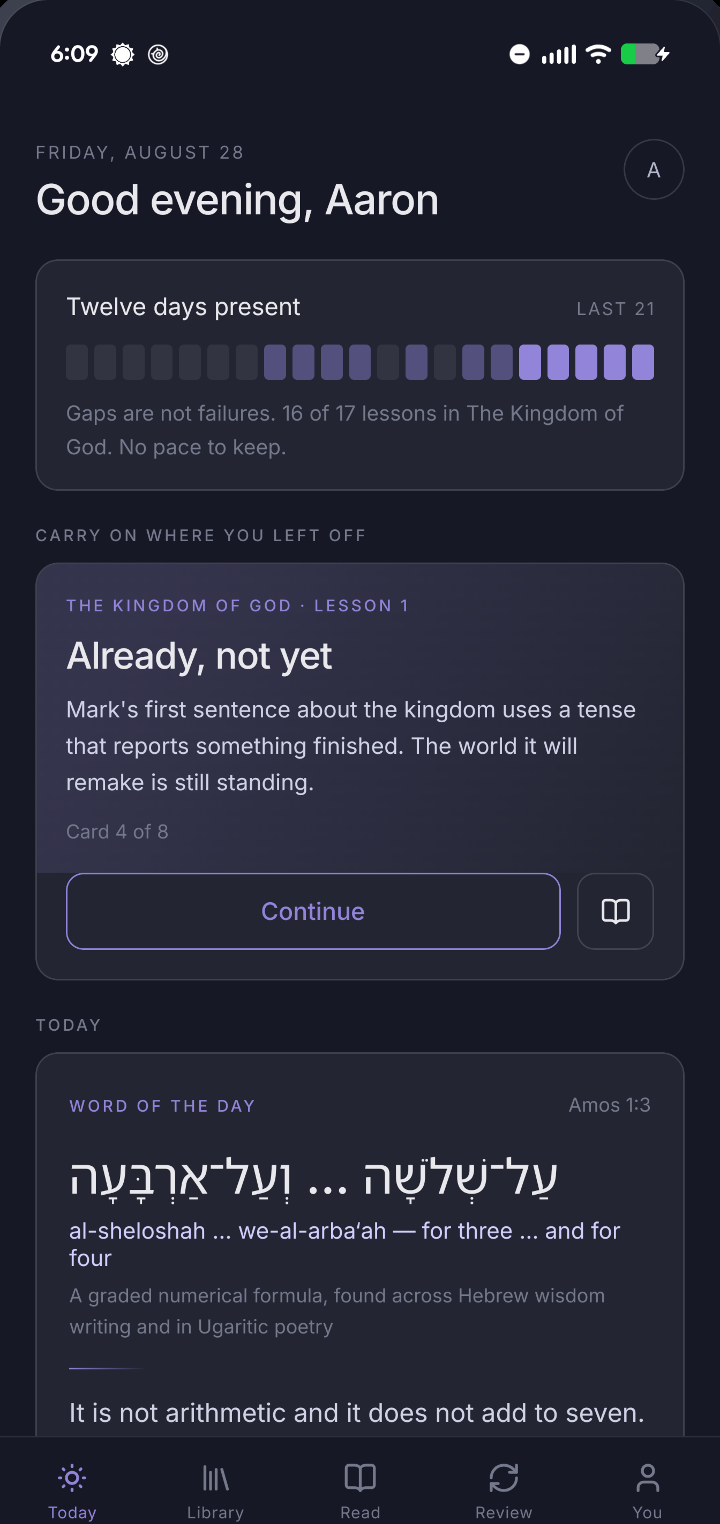
Historical context first, and the original languages where they change the meaning. The reading a commentary would ask somebody to do, already done, in the language people actually speak. No streaks, no points, nothing to keep up with.
A lesson is a short deck of cards. It sets the scene, reads the passage, stops to ask you something, and ends on one sentence worth keeping. Missing a day costs nothing, and the app never suggests otherwise.
Both open on threadbiblestudy.com, which is where the full picture lives.
For whoever is leading
Every lesson comes with notes for the person running the room.
All 182 of them. They are a briefing rather than a worksheet: how to open before anybody has read anything, roughly how long it runs, three questions with the reasoning behind each one, what to watch for, and how to end.
What to watch for
Each set names the loud snag and then the quieter one, which is usually the person the lesson was not aimed at who is hearing it as aimed at them.
Your church’s position is yours
Where a question divides serious Christians, the notes tell your leader to say your church’s position as your church’s. The curriculum points at the pulpit rather than filling that space.
Nobody is asked to confess
Notes may tell a leader how to hold a room. They never aim a question at a category of person, and never ask anybody to volunteer a wound out loud.
Four kinds of course
Sixteen courses, and they are not all doing the same job.
Book
One book, start to finish, in its own order. Ten of the sixteen: four through Genesis, four that carry Romans from its first line to its last, plus Jonah and Amos.
Theme
One idea traced across the whole Bible. The Kingdom of God from Daniel to Revelation, and the divine council in Who Else Is in the Room.
History
How We Got the Bible: copying, canon, translation, textual variants, and why your Bible has footnotes.
Questions
Once You Know, for passages that stop making sense in English until you have the missing piece. Hard Texts, for the ones that do not get better when you understand them. Open Questions, where every view is named and none is settled.
Course by course, lesson by lesson, with a real leader note printed in full: what’s inside, on Thread’s own site.
Free, for anyone who installs it
A Bible reader that works with no signal.
This part is not behind the plan. Anyone can install Thread and read.
Three translations
The Berean Standard Bible, the Berean Literal Bible, and the World English Bible, which carries the deuterocanonical books. All public domain, so none of it is anybody’s property to withdraw.
Read aloud
The whole Berean Standard Bible as audio, chapter by chapter, with proper transport controls and background playback.
On the phone, not the network
Download a translation and read it on a train. Highlights and notes made offline wait and sync when there is a connection.
The Bible’s own footnotes
The Berean’s footnotes and parallel passages, keyed to the verse, with a tap to peek at any cross reference without leaving the chapter.
Watch
Thread, walked through.
If you would rather read one than watch one, a whole lesson is on Thread’s own site, end to end, with nothing to sign up for.
Thread comes with Emberside, on one plan.
A church buys both together, for everyone it gives a seat to.